The most recommended kites for beginners are: Bow, Hybrid and Delta types. C-type kites are not suitable for beginners — their handling is very aggressive.
The main features of your first kite:
- Plenty of depower (reduces power), giving you a wider margin for error, good stability and kite control.
- The line setup can be 4 or 5 lines. We recommend 4-line kites — easier to rig — but some kites such as C-types need 5 lines to relaunch.
You need to ask yourself what kind of riding you'll do — your kite choice depends on it:
Freestyle: ride like a pro and try the latest tricks.
Freeride: ride and jump in all conditions — flat water, waves, chop — without worrying too much about which trick is in fashion (though that doesn't mean you shouldn't try them now and then).
Waveriding: a category of its own — only out when waves are over 1.5 m, riding a surfboard.
Kites for the different riding styles.
INFLATABLE KITES
C-type kites
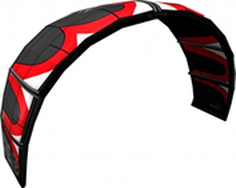
They have a fabric canopy with inflatable battens that keep the aerodynamic profile stable, and a main inflatable tube (leading edge) that holds the arc shape — although they are not easy to relaunch. These features make them the most used in kitesurf among pros and experienced kiters. Many brands offer this type. They keep evolving year after year.
Pros: Good upwind ability. Fairly stable, plenty of power for jumps and good hang time. Wide wind range (5 lines) and they handle gusty wind well.
Cons: Harder to relaunch from the water. If the kite cartwheels, the 5th line can split it in two, especially in the wave break zone.
Bow, Flat, Hybrid or 100% depower kites
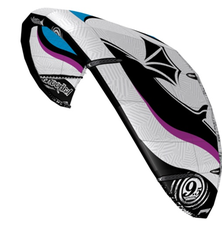
These kites also have a fabric canopy with inflatable battens that keep the aerodynamic profile stable, and a main inflatable tube (leading edge) that holds the arc shape — and they are easy to relaunch.
They keep the basic features of C-type kites but with a flatter wing design (lower arc) and pointed wingtips. They also have a bridled bridle along the leading edge for optimal penetration.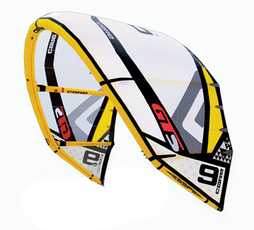
Pros: Maximum upwind capability (100% depower). Significantly larger projected area than the actual area, compared to C-type kites. Wider wind range. Very easy to relaunch from the water.
Cons: Less powerful while having more lift. Lower jump capability (less height and longer parabola).
FOIL KITES
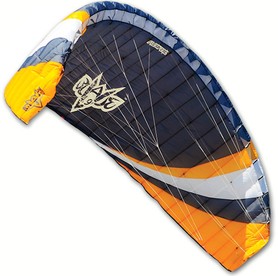
Similar to paragliders.
They have two layers of fabric (upper and lower surfaces) divided into several cells that inflate with air through the front valves to form their profile. They have a complex line system. They inherit all the knowledge of paraglider makers. Their poor flotation and precise handling make them most suitable for land use with a mountainboard.
Pros: Good traction. Some models rig up quickly. Generally more impact-resistant, but they can also blow up or tear their fabric. Easy to relaunch.
Cons: If they float for a few minutes, they fill with water and become hard to relaunch. Multiple control lines can tangle, especially in inexperienced hands. Some models take a long time to deflate when packing. If poorly tuned (or any line goes out of trim) the kite loses its profile and stops flying.
Another question you'll probably ask is what kite size should I use?
Kite size depends on your weight and the wind you usually ride in. For example, if you weigh 70 kg with 14 knots of wind you'll need a 12-metre kite, and at 20 knots an 8-metre. To pick a good size, the best thing is to drop by a specialist shop and they'll help you choose.
Keep in mind that if the size is too small you won't be able to get up and stay on course, while if it's too big you'll lose control.
If you want to try the sport to see if you like it, here's our advice on buying second-hand kites — they're much more affordable. Price depends on model, year, size and condition.
A new kite with bar costs between €1,000 and €1,500, while a second-hand one in good condition, 2 or 3 years old, should be in the €600–€800 range, depending on model and mid- or high-range.
WARNING: always look carefully at what's offered — if the kite is only 1 year old the price is rarely much lower than new.
To check that the kite is in good condition, here are some basic points:
It's very important to inflate the kite while inspecting it — that way you can see if it loses pressure and where.
Look at the control bar — the centre line is the most worn from bar friction. Find out which safety system it uses and the condition it's in.
Lines must be intact — no knots or chafing. Check the connections between the kite and the lines — wear is normal, but they should not be frayed.
Check the canopy for holes or chafing about to tear, especially at the side edges and folds.
One last tip — drop by Total Kitesurf and we'll help you get started in this sport.